

On August 11, 2026, HRSA released the Health Center Program Scope of Project Policy Manual (“Scope Policy Manual”) together with the Summary of Public Comments and HRSA Responses on the Draft Health Center Program Scope of Project Policy Manual (“Public Comment document”). Then, on August 14, 2026, HRSA released Program Assistance Letter (PAL) 2026-04, outlining the system improvements in HRSA’s Electronic Handbooks (EHBs) related to the scope of project updates outlined in the recently released Scope Policy Manual. On the same day, HRSA also added five additional FAQs on its Health Center Program Compliance Frequently Asked Questions (FAQ) page. (Update (9/24/2026): HRSA released a Health Center Scope of Project Policy Manual: Summary of Changes document and an explanatory video.) According to HRSA (announced on August 26, 2026), the Site Visit Protocol (SVP) will be updated to fully align with the Scope Policy Manual in February 2027. Until that update is complete, site visit teams will continue to use the current version of the SVP.
HRSA’s stated goal with these updates was to consolidate, streamline, and update scope of project policies in one document.
We have grouped the content into four major areas: substantial, clarifying, procedural, and editorial. Each of these areas contains multiple points for consideration.
Substantial Content includes information that is newly released with these documents that has implications for how health centers demonstrate compliance.
Clarifying Content groups clarifications and reiterations such as terminology updates or restating of information known from other sources.
Procedural Content identifies the points of procedure or how to implement a process with HRSA.
Editorial Content covers the previously represented material, layout, or other format-related points.
In the following paragraphs, all page number citations (e.g., “(p. 32)”) indicate the page of the Health Center Program Scope Policy Manual where the information can be noted.
Before we launch, it’s important to establish the definition of the scope of project.
Scope of project defined.
The health center’s scope of project is defined “as the HRSA-approved activities related to the HRSA-approved Health Center Program project, carried out on behalf of a health center, whether directly, by subawards, contracts, or by cooperative arrangements”. A health center’s scope of project consists of five key elements (p. 4):
Medically underserved population(s) and/or special medically underserved population(s) served by the health center (formerly “target population”, but renamed to align with the statutory language)
Service area
Services
Sites
Providers
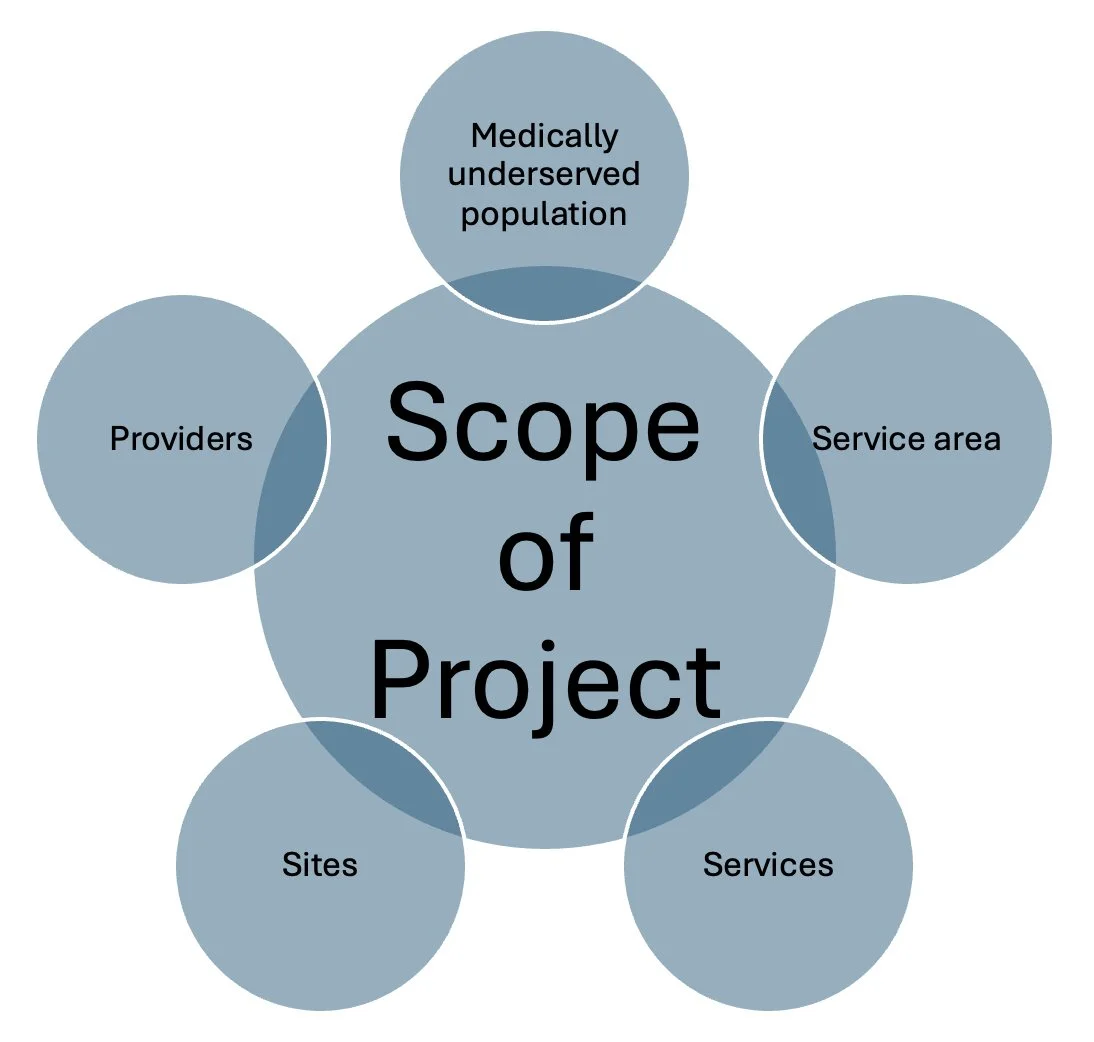
These five elements mark a service as part of the scope of project or being “in-scope”.
All in-scope activities are subject to all Health Center Program requirements as spelled out in the HRSA Compliance Manual and other HRSA regulatory documents. Specifically (p. 14):
The service is a required or additional health service.
The service is being provided on behalf of the health center.
The service is accessible to its patient population.
The health center’s governing board has approved the service.
A health center must ensure that health center patients have access to all HRSA-approved, in-scope services. However, the Scope Policy Manual now explicitly states that “a health center may establish a waiting list, based on its policies and operating procedures, due to high need” (p. 14).
“On behalf of” the health center.
Main Point(s):
HRSA is clarifying that in-scope means services provided by and for the health center.
HRSA clarifies that the general criteria for receiving approval of a scope of project depend on the demonstration that the activity will occur on behalf of the health center as part of the HRSA-approved Health Center Program scope of project.
This theme of “on behalf of the health center” is reiterated throughout the Scope Policy Manual. The criteria used to determine “on behalf of” include (p. 7):
The governing board approves the site or service
The activities are under the authority and direction of the board and in compliance with the health center’s policies and procedures.
They benefit the health center’s population, including the medically underserved population or special medically underserved population.
The services are provided by employees, contractors, and volunteers at approved sites or locations.
If provided by subaward, contract, or cooperative arrangement, the board has approved this method of delivery.
The services are provided using grant or non-grant funds, and when billed, have the sliding fee discount program applied.
Health records are established for all such activities.
Substantial Content
Quick Links:All Services are “available and accessible”.Telehealth for the service area and adjacent areas for a limited time.Credentialing and privileging of contracted providers.Monitoring contracts and cooperative arrangements (Columns II and III).Health center liability for activities outside the scope of project.75% ZIP Code threshold.Binding Column II contracts to federal and state laws.Sites have new names and types.Temporary service sites in response to HRSA-recognized emergency events.Clarify what types of changes in scope are needed and when each type is necessary.In-scope naloxone dispensing.
All Services are "available and accessible".
Main Point(s):
All services (not just Required Services) must be available and accessible to all patients.
Health centers must ensure that patients needing enabling services (e.g., interpretation or transportation) to access contracted, subaward, or contracted services receive that additional support.
Throughout the Scope Policy Manual, HRSA emphasizes that all in-scope services must be “available and accessible,” which is not the same as “directly provided”. In other words, both required and additional services must be available and accessible (pp. 10, 20, 26).
In practice, consultants have typically only applied this requirement to “required” services, while any “additional services” were considered “icing on the cake”. However, it is now clear that additional services that are offered must not be limited to certain populations – but that health centers ensure that all services (including those that are not “Required Services”) are “available and accessible for all residents”.
Related to accessibility, the Scope Policy Manual, in Footnote 43, calls out that Column II contracts and subawards must,
“…provide services that enable individuals to access primary care services (including outreach and transportation services and, if a substantial number of the individuals in the population served by the center are of limited English-speaking ability, the services of appropriate personnel fluent in the language spoken by a predominant number of such individuals)…” (p. 17)
In the Public Comment document, HRSA stated that it removed,
“the statement from Section 3.A that contracts, subaward agreements, and cooperative arrangements must include a provision addressing access for individuals with limited English proficiency.” (Public Comment, p. 18)
However, Sections C.2 and C.3 still require that a health center that delivers services through contracts, subaward agreements, or cooperative arrangements must ensure that all services are made available, including enabling access to health services for those with limited English proficiency (pp. 15-20).
This requirement can be demonstrated outside of the contract or cooperative arrangement through separate documentation agreed to by both the health center and the third party, reducing the need to revise existing agreements. The requirement in these sections is that the health center demonstrate that it can ensure translation and interpretation, as currently required.
Telehealth for the service area and adjacent areas for a limited time.
Main Point(s):
Health centers should provide telehealth services as a complement to in-person care in response to the needs and desires of the patient population.
Telehealth may be offered for patients located or residing in the service area or adjacent areas.
Telehealth services may be offered to patients who no longer live in the service area for a limited period of time.
In the Scope Policy Manual, telehealth (or telemedicine) is defined as a mechanism or means for delivering health services to health center patients using telecommunications technology or equipment. Telehealth is not meant as a substitute for in-person services, and the priority remains for in-person delivery whenever possible (p. 21).
A health center should consider the needs of the population served and seek patient input when deciding whether and when to provide services by telehealth. Some services are better suited for delivery via telehealth, and certain patient populations may be more likely to adopt telehealth. Before launching a broad telehealth strategy, health centers should consider these aspects first.
HRSA defined that telehealth services are to be offered for new and established patients who are located in or reside in the service area. They also allow for patients located in areas adjacent to the service area to be served in this way. Adjacent areas are defined as “1) The local jurisdiction (county, township, borough, parish, city, or equivalent type of minor civil division) adjacent to the area covered in whole or in part by the ZIP Codes, for each approved service site, as identified by the health center on its Form 5B: Sites (‘Form 5B’), and 2) Any ZIP Codes not identified on Form 5B, but that are within such local jurisdictions covered in part by the service area ZIP Codes” (p. 22).
Additionally, HRSA states that care can be continued for established patients for a “limited time” who no longer live in the service area. This timeline is to be decided by the health center in its policy, while HRSA provided a “1-year” example (pp. 21–23).
Commenters requested that PAL 2020-01 - Telehealth and Health Center Scope of Project be folded into the Scope Policy Manual. HRSA declined; it will remain active and should be referenced separately from the Scope Policy Manual as a way to separate policy from procedure.
Credentialing and privileging of contracted providers.
Main Point(s):
Health centers should have assurances of how credentialing and privileging is completed by external entities.
The Scope Policy Manual states that “a health center must ensure that each of its contracts or subawards for in-scope services” addresses (among other things) “how provider credentialing and privileging will be accomplished”. Later in the footnote, it states that the health center “determines how to implement credentialing and privileging procedures for a contractor. For example, an individual contracted provider or a locum will participate in the health center’s credentialing and privileging program. In another example, the contractor has its own credentialing and privileging program, and the health center has reviewed that program for compliance with Health Center Program requirements” (p. 16). Later, it states that the health center “determines how to implement credentialing and privileging procedures for a contractor-operated site. For example, the contractor has its own credentialing and privileging program, and the health center has reviewed that program for compliance” (p. 38).
For related information on credentialing and privileging assurances, see our blog on the topic.
The Public Comment document states that HRSA will revise the Site Visit Protocol after the Scope Policy Manual is published to align with these updates (Public Comment, p. 24).
Monitoring contracts and cooperative arrangements (Columns II and III).
Main Point(s):
Health centers are accountable for ensuring services delivered via Column II and Column III methods meet the same standards as Column I delivered services.
Patient appointment assistance is required for cooperative arrangements when patients have no other choice.
Throughout the Scope Policy Manual, HRSA reiterates that a health center must oversee the contractual arrangements to ensure that services provided on behalf of the health center “are delivered according to the terms of the arrangement” and are delivered “in accordance with Health Center Program requirements”.
This clarification is in line with the November 2025 updates to the HRSA Site Visit Protocol, which allow for health centers to provide performance monitoring for contracts in accordance with their own internal policy and procedure rather than articulating these in each individual contract.
Similarly, HRSA emphasized that “providing services via a cooperative arrangement is more than just a referral”. Specifically, the Public Comment document clarifies that health centers must provide appointment assistance to access services provided by a cooperative arrangement. Health centers should take note that just providing the name and phone number of the service is unlikely to be compliant.
HRSA clarified that health centers must also maintain responsibility for any follow-up care, based on the care and follow-up instructions provided by the other party. Follow-up care includes the health center’s own treatment plan for the health center patient (p. 18).
Often, health centers take a passive stance regarding Column II and III arrangements, whereas HRSA is clarifying that the same level of scrutiny applied to Column I services must also apply to Columns II and III.
Health center liability for activities outside the scope of project.
Main Point(s):
HRSA acknowledges that FTCA-deemed entities may have reason to seek gap or wrap-around malpractice coverage for services and activities outside the scope of project.
In the Public Comment document, HRSA acknowledged “that a health center may have concerns regarding potential liability associated with choosing to use a contract or cooperative arrangement as the service delivery method for an in-scope service, as it relates to the ‘on behalf of’ criteria. A Federal Tort Claims Act (FTCA) covered entity should consider gap or wrap-around malpractice protection for services and activities outside the Health Center Program’s scope of project. A health center also has flexibility in choosing what service delivery methods it uses to provide required and additional health center services. HRSA further clarified in the final policy that the term ‘on behalf of’ as used in the Scope Policy Manual applies specifically to Health Center Program scope of project determinations and does not alone establish a principal-agent relationship or any other representative relationship” (Public Comment, p. 20).
This guidance appears to offer a relatively new take, encouraging FTCA-deemed health centers to consider supplemental insurance for out-of-scope services on a health center’s Form 5A as Column II or III services.
75% ZIP Code threshold.
Main Point(s):
In the annual service area review, health centers should identify the intended medically underserved population.
HRSA provided clarification regarding the required annual review of the service area to include at least 75% of the health center’s patient population, saying that health centers,
“…must annually review the boundaries of the catchment area to be served [service area] by the health center, including the identification of one or more medically underserved populations within the catchment area, to ensure that”…“This area as documented by the ZIP Codes reported on the health center’s Form 5B: Sites (Form 5B) includes, at a minimum, those ZIP Codes where at least 75 percent of current health center patients reside, based on patient origin data submitted by the health center through the Health Resources and Services Administration’s (HRSA) Health Center Program Uniform Data System (UDS).”
Many health centers already annually review the service area on their own or by contracting with RegLantern to provide a review map. However, HRSA clarifies the need to state the intended medically underserved population, defined as an area or population “designated by the Secretary as having a shortage of personal health services”. This is something typically reserved for the Service Area Competition grant application or New Access Point application and is now clearly stated to be annual.
Binding Column II contracts to federal and state laws.
Main Point(s):
Agreements must be fully executed and may be evergreen.
Agreements must address federal and state laws regarding privacy, grant regulations, and civil rights.
In agreement with the updated Site Visit Protocol, the Scope Policy Manual requires that a health center,
“must ensure that each of its contracts or subawards for in-scope services is current, executed by all parties (for example, a signed paper copy, electronically-signed documents, emails documenting acceptance), and addresses (among other things), the applicability of federal and state laws including those related to patient privacy, HHS grant regulations, and civil rights”.
Commenters asked HRSA to remove the requirement regarding patient privacy, HHS grant regulations, and civil rights. HRSA declined, but stated that, in counsel with legal advice, health centers may be able to have a general “catch-all” provision, stating that both parties will comply with all laws.
In addition to being fully executed, HRSA also stated that all contracts must be “current” and clarified that “evergreen” or auto-renewing contracts satisfy that requirement. This is a helpful clarification for health centers during an Operational Site Visit (OSV), when reviewers object to the age of a document.
Sites have new names and types.
Main Point(s):
HRSA has updated the terminology and selections to provide better alignment to site designations in practice.
In the Scope Policy Manual, HRSA updated language from “Service Sites” to “Sites”, allowing this terminology to include administrative sites or other sites that did not provide patient services.
HRSA clarified that the health center governing board is responsible for approving the addition of each service site, the hours of operation, and services to be provided at the service site.
Service Sites now have Service Site Setting options:
Freestanding
Co-located with Hospital
Co-located with School
Co-located with Behavioral Health Organization
Co-located with Domestic Violence Shelter
Co-located with Another Organization
Other Site is a new site type that includes:
Administrative Site
Patient Support Services Site
Pharmacy-Only Site
Additionally, the Transitional Care in Carceral Setting (TCCS) Site is added as a new site type to align with the additional question in the Site Visit Protocol.
Temporary service sites in response to HRSA-recognized emergency events.
Main Point(s):
HRSA clarifies the use of in-scope services during emergency events.
HRSA clarified that a health center may request a change in scope of project to temporarily add a service site to provide in-scope services in response to an emergency event(s) by using a streamlined HRSA notification and approval process. HRSA added that service area limitations will be evaluated on a case-by-case basis. It was also clarified that during declared emergency situations, health centers may provide services at specific locations on an ad-hoc basis rather than on a regularly scheduled basis.
HRSA clarified that PAL 2020-05 would remain active and should be referenced separately from the Scope Policy Manual.
Clarify what types of changes in scope are needed and when each type is necessary.
Main Point(s):
HRSA is reducing the approval burden for many Change In Scope (CIS) types.
There are three different types of change in scope requests:
Formal CIS request (requires HRSA review and approval)
Scope Adjustment CIS request (requires HRSA review and approval)
Self-Update (does NOT require HRSA review and approval)
Formal CIS requests (requiring HRSA review and approval) are requested when:
Adding or deleting a service or service delivery method; or
Adding or deleting a site, including moving a site from one physical address to another.
Scope Adjustments (requiring HRSA review and approval) are requested for:
A required service where a newly funded or newly designated health center failed to verify the service was implemented within 120 days of the initial funding or designation notice,
An existing service where the requested change is adding either a Column I or Column II service delivery method on Form 5A, or
Information about a site (such as hours of operation, months of operation, ZIP Codes).
Self-Updates may be completed in the following circumstances (with no HRSA review or approval required):
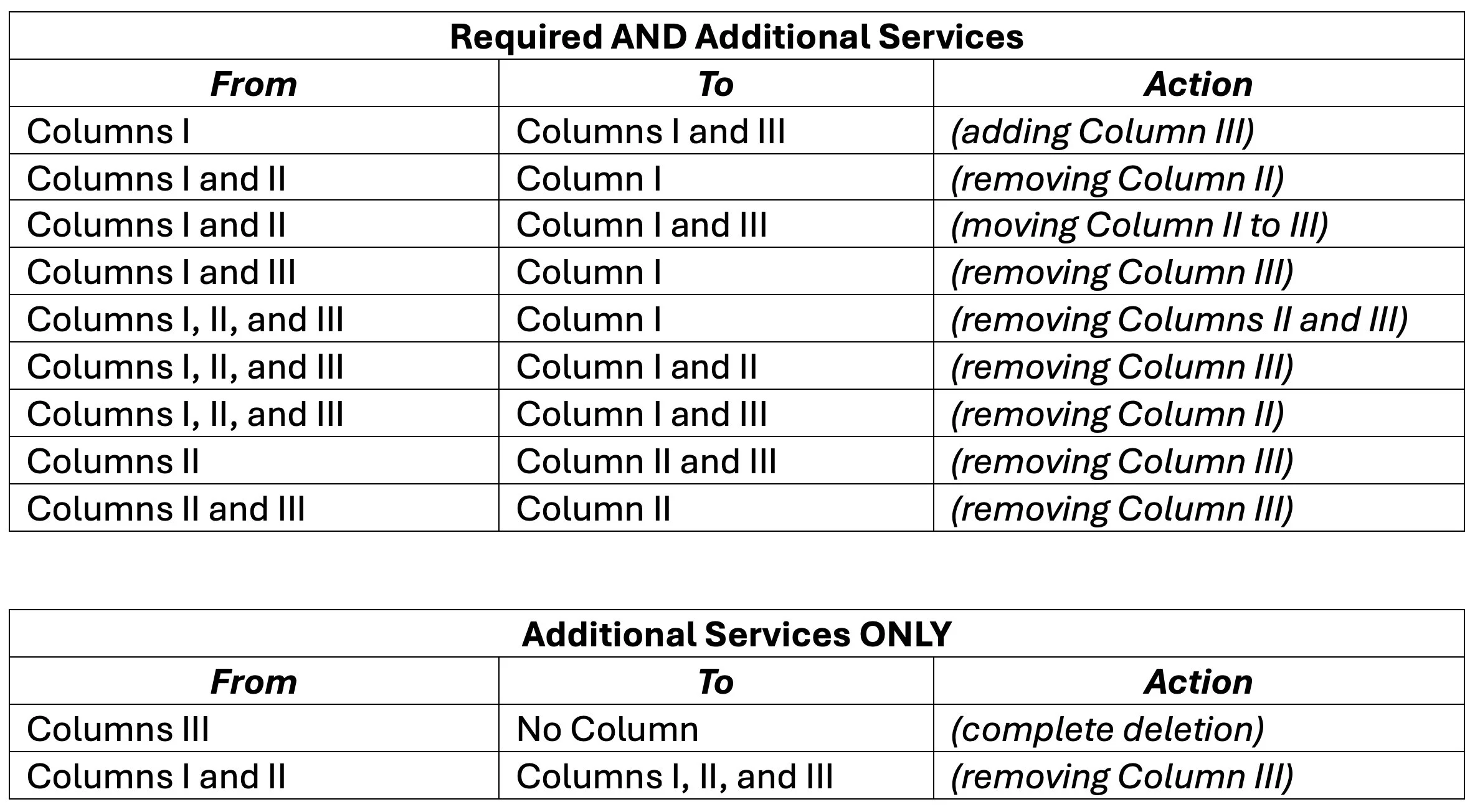
Modifying Service Delivery Methods Via Self-Updates, adapted from HRSA PAL 2026-04, Appendix A, p. 8.
In-scope naloxone dispensing.
Though not in the Scope Policy Manual, HRSA released a related memo on August 17, 2026, outlining when the prescribing and dispensing of naloxone may be considered to be within the Health Center Program scope of project. HRSA advised that all of the following must apply to be considered “in-scope”:
Such prescribing or dispensing occurs at a health center service site or at offsite locations within the community served by the health center and where the health center is providing care (including at offsite programs or events carried out by the health center), whether in-person or through telehealth.
Prescribing or dispensing is conducted on behalf of the health center.
The health center maintains a record of each encounter to the extent practicable, including the service(s) provided, the location where services were administered, the name of the provider(s) administering the services, and the date and time the services were administered, and where possible, the individual who receives the prescription or dispensing of naloxone.
Health services provided under a contractual arrangement between a health center or a health center provider, and a third-party entity or individual are not addressed by this determination of coverage.
Activities undertaken by the health center for the sole benefit of employees, family, or other associates of an entity, company, or corporation that are not made available to all patients of the health center or to all members of the community are not eligible for coverage.
HRSA determined that FTCA coverage of this service benefits patients and communities as health centers try to address the opioid overdose challenge in the nation. HRSA also noted that this determination is temporary and will expire by August 17, 2027.
Clarifying Content
Quick Links:Clarify and update Form 5A language.Excess program income and non-grant funds.Exempt enabling services.Governing board responsibilities related to scope of project.Provide clarifying examples.Services provided by other FQHCs.
In many cases, the information below is covered in other HRSA documents. In some cases, terminology has been updated, or there is a clarification or reiteration worth noting.
Clarify and update Form 5A language.
The following names for columns and services have been updated with the Scope Policy Manual.
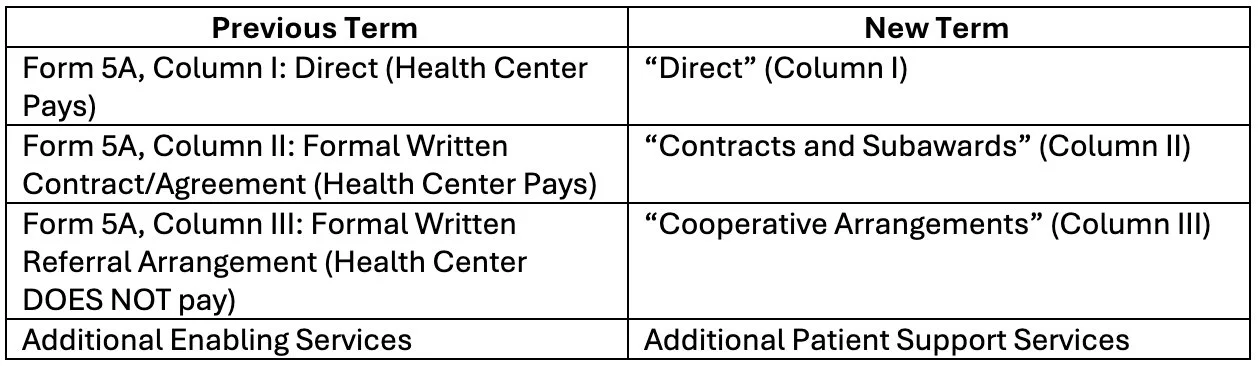
HRSA has reiterated that “Specialty Services” is actually a sub-category of “Additional Services”. This means there are only two types of services: “Required” and “Additional”.
Regarding Column III Cooperative Arrangement, the Scope Policy Manual notes that these are used in “limited situations”. The manual states Cooperative Arrangements are for when
“a patient can only access a service through a cooperative arrangement when either: (1) The health center does not offer the service through another service delivery method, or (2) The other service delivery method is not accessible to the patient because the service is provided directly only at a service site that is a significant distance from the impacted patient”.
And though the health center is not responsible for overseeing the delivery of the service in the cooperative arrangement, it is responsible for oversight of the terms of the agreement and must assist patients in accessing the care and follow-up after the care is delivered. This is a critical component of maintaining continuity of care and ensuring that the health center’s patients do not fall through the cracks in the country’s complex healthcare system.
HRSA does not consider the required primary or additional health services provided through the cooperative arrangement (Column III) themselves to be in the scope of project of the health center establishing the cooperative arrangement. HRSA only considers the “cooperative arrangement activities” (for example, assisting the patient in making the appointment, follow-up care, and coordination) carried out by the health center establishing the cooperative arrangement to be in the health center’s scope of project.
The HRSA Form 5A Service Descriptors document now reflects the updated name for “Additional Enabling Services” as “Additional Patient Support Services”.
NOTE: Numerous other changes were made in the HRSA Form 5A Service Descriptors document that are outlined in our related blog post.
Excess program income and non-grant funds.
HRSA confirmed that excess program income can be used to fund other lines of business. However, health centers should be careful to review the Notice of Award (NoA) and other grant requirements to ensure that these other lines of business are benefiting the target population and are not expressly prohibited by federal grant requirements.
Exempt enabling services.
HRSA clarified that enabling services (transportation, translation, and outreach) are exempt from certain HRSA requirements for contracts and cooperative arrangements, including quality assurance/improvement, credentialing, and sliding-fee requirements. This is in line with current verbiage in the Site Visit Protocol.
Governing board responsibilities related to scope of project.
Ultimately, the governing board is accountable for determining the health center’s scope of project. According to HRSA, the governing board must approve the health center’s:
Sites
Hours of operation
Services
Service delivery methods
Total budget for the scope of project
Proposed changes to the scope of project (i.e., populations served, sites, services, service area, etc.)
These approvals should be guided so that health center services are “responsive to the health needs” of the population served by the health center. This is one of the primary reasons HRSA requires that 51% of board members are patients, ensuring the “voice” of the patient is always at the center of the health center’s work.
Once the board approves these elements, HRSA evaluates the submitted scope and ensures that the health center demonstrates that “the services delivered, sites operated, and activities conducted will occur on behalf of the health center as part of the HRSA-approved Health Center Program scope of project”, as outlined above.
Health centers may choose to engage in other activities that are outside of the purposes of the HRSA Health Center Program. These are considered “other lines of business” and are not eligible for federal funds or benefits. These activities must be funded with non-grant funds and must fall outside the health center program budget.
Provide clarifying examples.
The Scope Policy Manual reiterates that health centers with subrecipients must monitor on an ongoing basis that the subrecipient is in compliance “with Health Center Program requirements, the terms and conditions of Health Center Program funding, and all other applicable federal laws, regulations, and policies”.
NOTE: RegLantern has tools for this! If you have a subrecipient you need to monitor, set up a 15-minute call with us to see how we can help you meet these HRSA requirements.
Services provided by other FQHCs.
In line with past expectations, HRSA expressed its intent to support collaboration between health centers. HRSA reiterated that the goal is to ensure that the highest number of patients are served as possible.
Procedural Content
This content addresses procedures or the manner in which specific activities are to be carried out in response to the Scope Policy Manual.
Scope of project correction opportunity.
HRSA confirmed that it would provide health centers a chance to respond to a non-compliance notice before taking action. This addressed numerous comments requesting HRSA provide advance written notice before an approved service/site is removed from scope.
Board approval of contracts and cooperative arrangements.
HRSA clarified language in the Scope Policy Manual to indicate that the board needs only to approve the initial service delivery method decision, rather than approving every contract themselves, based on comments expressing concern that the board would have to approve every contract and cooperative arrangement.
Health records vs contractor records.
HRSA clarified that health centers must retain contractor records but not necessarily be the custodian of records for the contractor. Though requested, HRSA declined to exempt any delivery method from this requirement.
Editorial Content
These updates include layout, scope, location, or other editorial decisions related to the new manual.
Remove scope of project process-related instructions.
Main Point(s):
HRSA is maintaining several process-related items online instead of in these documents.
In the Scope Policy Manual, HRSA removed many of the scope of project process-related instructions. Process-related instructions remain available on HRSA’s website at Scope of Project Resources.
Consolidate guidance into one document.
Main Point(s):
The Scope Policy Manual serves to consolidate and replace many previous official HRSA documents.
The Scope Policy Manual supersedes the following scope of project Policy Information Notices (PIN):
PIN 2007-09: Service Area Overlap: Policy and Process
PIN 2008-01: Defining Scope of Project and Policy and Process
PIN 2009-02: Specialty Services and Health Centers’ Scope of Project
PIN 2009-05: Policy for Special Populations-Only Grantees Requesting a Change in Scope to Add a New Target Population.
Other resources and guidance still stand and are referenced in the document:
HHS Grants Policy Statement at HHS Grants Policies & Regulations
Health Center Volunteer Health Professionals (VHPs) Application
PIN 2011-02: Free Clinics Federal Tort Claims Act (FTCA) Program Policy Guide
Still have Scope Policy Manual questions? Share them with HRSA via the BPHC Contact Form. Select “Health Center Program Policy and Information”, then “Scope Manual General Inquiry”.
Would you like to talk through the finer points of this topic with our RegLantern team of HRSA and FTCA experts? Contact us today or set up a 15-minute call with us!

AI Disclosure
This blog post was created 100% without the assistance of generative Artificial Intelligence (AI). It was written by real, living (albeit fallible and quirky) humans (specifically, Kyle Vath and Lance Luttrell).
UPDATED (9/9/2026): Updated blog post to include information about FTCA coverage of Naloxone dispensing.
UPDATED (10/6/2026): Updated blog post to include HRSA’s newly released Health Center Scope of Project Policy Manual: Summary of Changes, and an explanatory video and slides.