

FTCA Coverage Eligibility of Individuals
Our team will often get questions like, “Will XYZ individual be covered under FTCA?” The answers to these questions are often complex and buried in HRSA policy manuals. They are rarely quick and straightforward answers, but rather result in a great deal of back-and-forth follow-up questions before we get to an answer to the question. So we thought we would do our best to lay the groundwork for this topic in a blog post.
First, a quick disclaimer: Only HRSA/FTCA can officially determine whether a provider will be covered or not, as each situation is unique with lots of variables. So, none of this should be viewed as legal advice, as I am not an attorney. However, I can point you to what HRSA/FTCA states about the eligibility of clinical staff generally. For specific, situation-based clarification, it’s best to contact the HRSA FTCA program for authoritative confirmation.
When considering whether an individual is eligible for FTCA coverage or not, it’s important to gather some key information:
What is the individual’s employment relationship with the covered entity (health center)? Employee (W-2)? Volunteer? Contractor (1099)? If a contractor, is the contract an individual contract, an organizational contract, or an eponymous contract?
Is the individual an unlicensed or uncertified clinical staff member (“Other Clinical Staff” or “OCS”)?
If a contractor, how many hours per week will they be working (more or less than 32.5 hours/week)?
If a contractor, are they working at least an average of 32.5 hours a week or more?
If a contractor, is their field of practice family medicine, obstetrics, gynecology, general internal medicine, or general pediatrics?
What services is the individual providing on behalf of the health center (as recorded on FTCA-deemed facility’s Form 5A)?
Once you gather this information, reference the table below, based on the regulations outlined in the Federal Tort Claims Act Health Center Policy Manual.
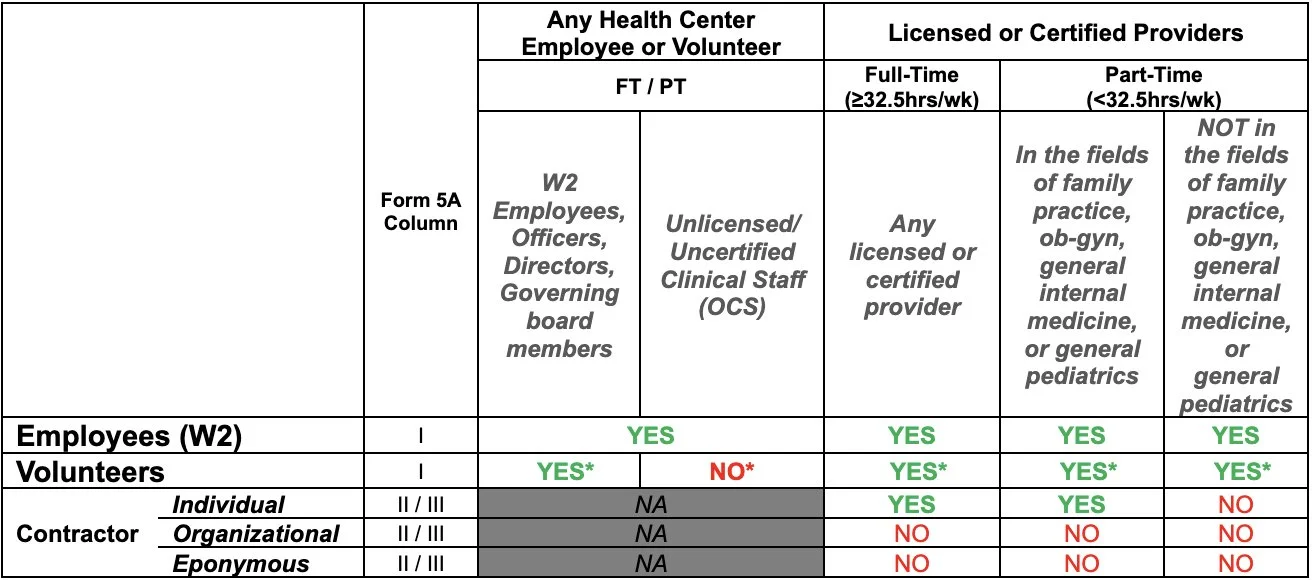
TABLE: FTCA Staff Eligibility
*Volunteers:
Volunteers who are not licensed or certified are not eligible for FTCA/VHP coverage.The service must be provided to the individual at the facilities of a deemed health center, or through off-site programs or events carried out by the entity.The volunteer health care practitioner must be sponsored by the deemed health center.The health care practitioner must not receive any compensation for the service from the individual, the deemed health center, or any third-party payer (including reimbursement under any insurance policy or health plan, or under any Federal or State health benefits program), except that the health care practitioner may receive repayment from deemed health center for reasonable expenses incurred by the health care practitioner in the provision of the service to the individual, which may include travel expenses to or from the site of services.Before the service is provided, the health care practitioner or the deemed health center must post a clear and conspicuous notice at the site where the service is provided of the extent to which the legal liability of the health care practitioner is limited pursuant to this subsection.At the time the service is provided, the health care practitioner must be licensed or certified in accordance with applicable Federal and State laws regarding the provision of the service.At the time the service is provided, the deemed health center must maintain relevant documentation certifying that the health care practitioner meets the requirements of this subsection.VHPs are not automatically eligible for liability protections under the Health Center FTCA Program, and deemed health centers must apply for such protections for individual volunteers through a VHP deeming sponsorship application. The deemed health center must submit to HRSA and receive approval of a VHP deeming sponsorship application for each individual volunteer. (https://bphc.hrsa.gov/compliance/ftca/faq#volunteers)
NOTE: An “Eponymous Contractor” may be a new phrase for some. This is defined as a “professional corporation to which one has given one’s name, e.g., John Doe, LLC, and consisting of only one health care provider”. These types of corporations are not covered under FSHCAA and the FTCA.
If you’d like more information or clarification, it’s important to reference the actual source document and consult your health center’s legal counsel before making business or legal decisions.
Additionally, if you determine that an individual is eligible for FTCA coverage under your FTCA-deemed health center, know that all of the HRSA/FTCA requirements must still be maintained for each individual. This includes required trainings, credentialing, and privileging, etc.
Would you like to talk through the finer points of this topic with our RegLantern team of HRSA and FTCA experts? Contact us today or set up a 15-minute call with us!

AI Disclosure
This blog post was created 100% without the assistance of generative Artificial Intelligence (AI). It was written by a real, living (albeit fallible and quirky) human (specifically, Kyle Vath).
Subscribe to the RegLantern Blog
Get the latest posts delivered right to your inbox
RegLantern provides HRSA compliance services (including mock site surveys) and online tools to assist your health center with continual compliance.