

HRSA archived Form 5C on November 20, 2026, as part of its scope system improvements. Previously, HRSA’s Form 5C: Other Activities/Locations was where health centers documented activities such as immunizations, hospital admitting, medical rounds, home visits, health fairs, non-clinical outreach, portable clinical care, health education, and other activities. Each health center still has access to an archived copy of Form 5C in EHBs (Health Center Program Compliance FAQs) should they wish to reference it in the future.
So what do we do now that Form 5C is gone? Moving forward, health centers will be responsible for determining whether the activities and locations previously documented on Form 5C meet the criteria in Chapter 9 of the Health Center Program Scope of Project Policy Manual (“Scope Manual”).
Services listed on your Form 5A and delivered at a site on your Form 5B are in scope when they meet the Scope Manual’s criteria.
According to HRSA’s Scope Manual, health center services provided to an established health center patient, as part of continuity of care, at a location that is not a HRSA-approved service site (for example, the health center provider conducts home visits for primary care or the provider rounds on hospitalized health center patients after labor and delivery) are within the scope of the health center project when all the following criteria are met:
The health center provider is either employed or individually contracted by the health center;
The service provided is an in-scope service (Form 5A); and
The health center documents the encounter in the patient’s health center record.
A health center may also provide in-scope services on behalf of the health center to individuals who are not established patients of the health center at a location that is not a HRSA-approved service site if all the following criteria are met:
The health center provider is either employed or individually contracted by the health center;
If the service generates a patient visit, the health center documents the visit in a record that identifies the provider, the individual served, the service(s) provided, and the date of service; and
The in-scope service provided falls within one or more of the following categories: Portable Care and Outreach, Hospital-Related Activities, Coverage-Related Activities, Emergency Response Activities, Certain Individual Emergencies (Learn more about these requirements in Chapter 8 of the Scope Manual).
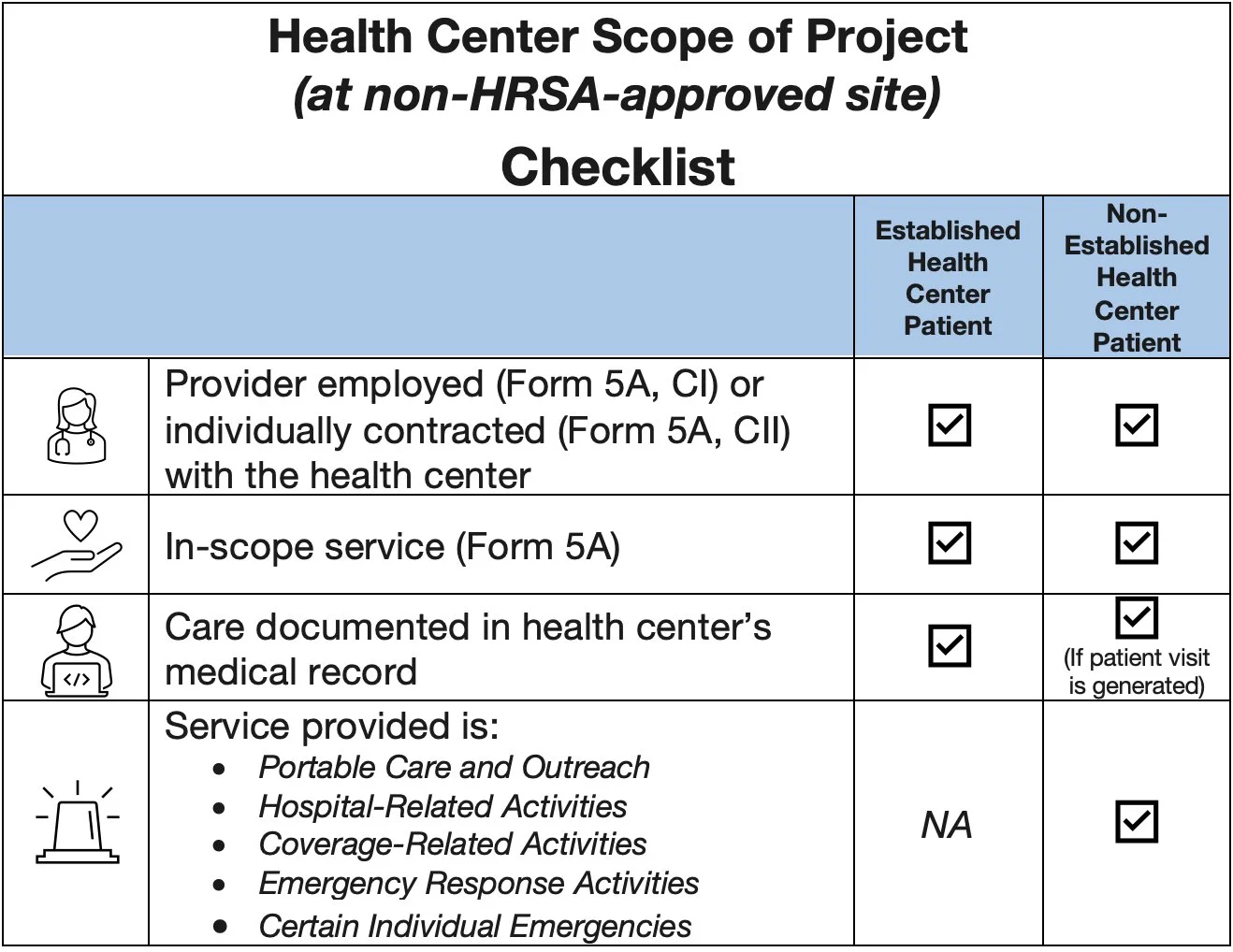
If health centers meet all of the above criteria, these services will be considered to be within the scope of project for the health center. Health centers do not need to request HRSA approval or submit formal documentation for these activities (Health Center Program Compliance FAQs). However, centers must maintain their own records documenting alignment with these requirements.
For health centers that are FTCA-deemed, getting this right is important for medical malpractice coverage. FTCA considers only services within the deemed health center’s scope of project to be eligible for FTCA coverage. So, if the care provided does not meet the above criteria, the health center may have legal exposure and need supplemental coverage.
What to Do Now
Export your archived Form 5C from EHBs.
For each activity, decide which path applies: established patients, or one of the five categories for non-patients.
Confirm the service is on Form 5A and the required documentation is in place.
If you’re FTCA-deemed, confirm each provider is a covered individual.
Stop or restructure anything that is not aligned with the requirements.
If you have any questions about your health center’s scope of project, contact one of our health center compliance experts today! We’ll check your archived Form 5C line by line against the Chapter 9 requirements and help you close any compliance gaps. Or, contact HRSA/BPHC on their BPHC Contact Form.

AI Disclaimer
This blog post was created 100% without the assistance of generative Artificial Intelligence (AI). It was written by a real, living (albeit fallible and quirky) human (specifically, Kyle Vath).