

A frequently asked question of our team is “What’s the difference between credentialing and privileging?” This is also the single most-searched related query on Google searches. Not only that, but credentialing and privileging regulations are the #3 and #5 most common findings (areas of non-compliance) noted during a HRSA Operational Site Visit (OSV) that comes around every four years. Additionally, credentialing and privileging concerns are issues that commonly surface during Federal Tort Claims Act (FTCA) application reviews and Site Visits. This post will discuss credentialing and privileging and place the topic squarely in the context of HRSA community health center (Federally Qualified Health Centers or “FQHCs” and Look-Alike health centers or “LALs”) regulations and operational best practices.
Many sectors of healthcare refer to credentialing and privileging in different terms. The Joint Commission refers to processes that ensure clinical staff are delivering safe, high-quality patient care as “Focused Professional Practice Evaluation (FPPE) or Ongoing Professional Practice Evaluation (OPPE). But, for health centers, HRSA defines credentialing and privileging as a process that must include all clinical staff (which includes “Licensed Independent Practitioners” (“LIPs”), “Other Licensed or Certified Practitioners” (“OLCPs”), and “Other Clinical Staff” (“OCS”)) who are “employees, individual contractors, or volunteers”. For all of the requirements spelled out by HRSA during this credentialing and privileging cycle, they must be verified “upon hire and on a recurring basis” (except for identity and education as listed below). For FTCA-deemed community health centers, the “recurring basis” must be no less frequent than every two years.
Since most FQHCs are FTCA-deemed and LALs or other non-FTCA-deemed health centers commonly choose the same frequency of every two years, throughout this article, we will simplify our language to a blanket “upon hire and at least every two years”.
So, who are these “other clinical staff”? HRSA provides these examples for LIPs, OLCPs, and OCS:
“LIPs” may include physicians, dentists, physician assistants/associates, nurse practitioners, or clinical psychologists, etc.
“OLCPs” may include registered nurses, licensed practical/vocational nurses, registered dietitians, certified medical assistants, phlebotomists, respiratory therapists, licensed or certified behavioral health support staff, etc.
“OCS” include unlicensed or uncertified staff who are providing services on behalf of the health center and may include medical assistants, peer navigators, or community health workers in states, territories, or jurisdictions that do not require licensure or certification.
For questions about when these requirements do or do not apply to certain supervisors, peer reviewers, or administrators who do not see patients, check out our blog post on the topic.
Credentialing
Credentialing “assesses if a provider meets institutional requirements for staff inclusion, such as training, board certification, and malpractice event history” (King, R.W., et al).
The verifications HRSA requires for credentialing include:
Government-issued picture ID: Verifying a photo ID allows the health center to verify that the clinical staff member is who they say they are. Most community health centers use a state driver’s license or a federal passport to accomplish this verification. This is only needed to be verified upon hire or if a significant part of their identity has changed (married name change, etc.). As long as the identification proof was verified as part of the health center’s credentialing and privileging processes, a copy of the actual identification documentation (for example, state driver’s license) is not required to be in the health center's files or records. However, some documentation must be kept on file documenting that it was verified by the authorized health center staff. In general, it is not necessary to get a new copy of this identification when the document expires. Again, once the health center has initially verified that the staff member is the person they say they are, the health center’s responsibility has been fulfilled.
Education and Training: For each clinical staff member, the related education and training required for their role must be confirmed by primary source documentation. The health center may rely on a state licensing agency, specialty board, or registry to verify education and training if the health center can document that these agencies conduct education and training primary source verification when issuing the license or certification. If your health center uses such a source, document annually that the state licensing agency continues to conduct primary source verification (See Figure 1 below). If the health center chooses to go straight to the academic institution, a primary source document should be requested and filed upon hire (e.g., certified transcripts, etc.). Like identity, verification of education and training is required only initially upon hire or if the staff member’s role changes and requires additional education or training. A good example of when a staff member’s verification must happen outside of the initial hiring is if a staff member begins their employment with the health center as an RN and, after working at the health center for some time, decides to go back to school to be a nurse practitioner. In this circumstance, the health center would need to verify the staff member’s education and training by primary source before allowing them to work under their new license as an advanced practice nurse. In most circumstances, standard continuing education (“CEs”) documentation (commonly required by state licensing agencies to maintain licensure) does not need to be verified or maintained in the employee’s file, unless that training is required by the health center’s policies or if the training was required for some of the privileges being granted by the health center.
Licensure, Registration, or Certification: For both LIPs and OLCPs, the health center must document any licenses, registration, or certifications by primary source upon hire and at least every two years. For most health centers, primary source verification is printed off the state’s relevant licensing confirmation website. By definition, “Other Clinical Staff” are not licensed or certified. So, this requirement is not applicable to OCS.
National Practitioner Data Bank: For all LIPs, OLCPs, and OCS, the health center must run a query report from the National Practitioner Data Bank (NPDB) upon hire and at least every two years. For more information, please read our related blog post.
Drug Enforcement Administration (DEA) registration: If a provider is registered with the DEA to prescribe controlled substances, the health center must verify documentation upon hire and at least every two years.
Basic Life Support (BLS) training: For all LIPs, OLCPs, and OCS, the health center must verify current and unexpired BLS (or greater) training upon hire and at least every two years. For more information, please read our related blog post.
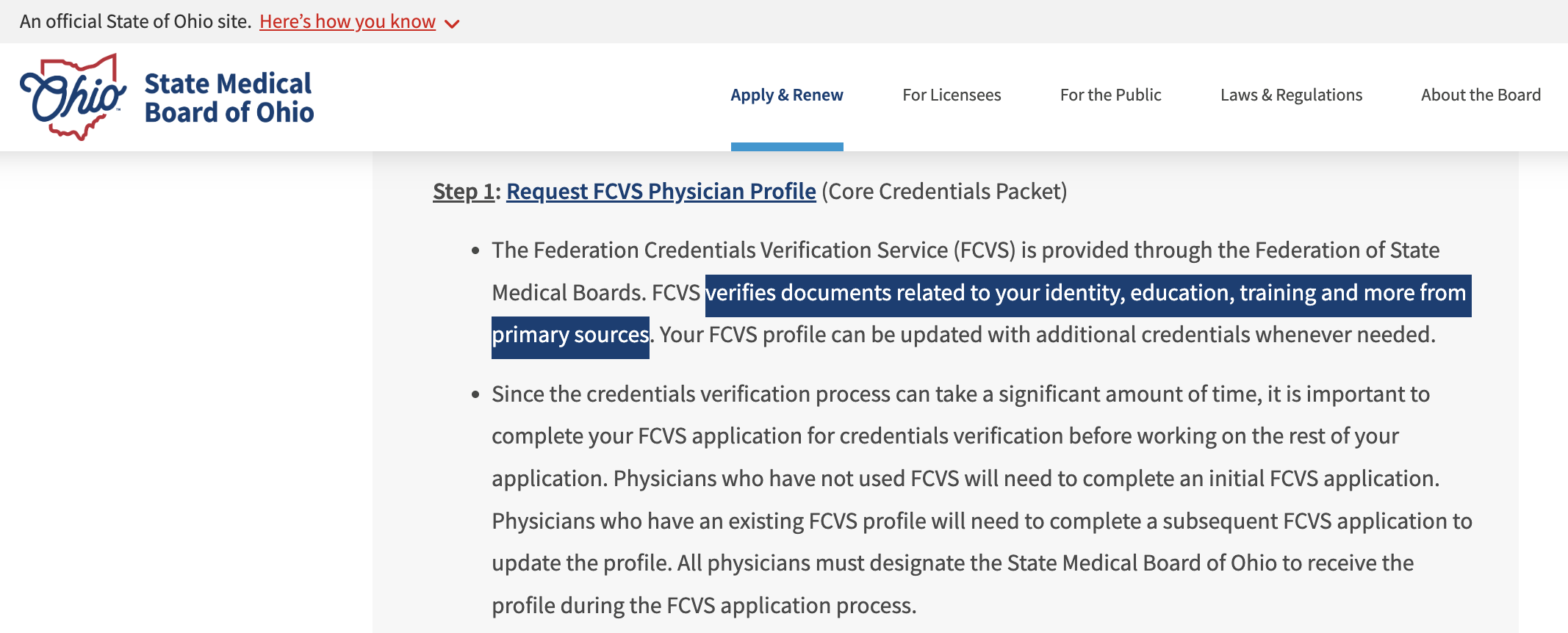
Figure 1: An example of a state verifying education and training by primary source.
Privileging
Privileging, on the other hand, “evaluates a provider's behavior, skills, and procedures within their practice scope at the institution” (King, R.W. et al). This verification is specific to the health center itself and the skills the health center leadership has granted the clinical staff member as part of their “scope of practice”. The AMA defines a clinician’s “Scope of practice” as “those activities that a person licensed to practice as a health professional is permitted to perform” and are usually “determined by statutes enacted by state legislatures and by rules adopted by the appropriate licensing entity” (AMA). Since each health center takes on the liability of having clinical staff members provide care to patients on their behalf, the health center is responsible for granting specific privileges within that “scope of practice”, and has the obligation to verify the clinician is clinically-competent and fit to perform those granted privileges.
The verifications HRSA requires for privileging include:
Fitness for Duty: The health center must verify that each clinical staff member is both physically and cognitively fit to perform the duties of their job and the privileges granted to them by the health center. The “how” you verify the staff member’s fitness for duty is up to the health center to define in the health center’s operating procedures. Please read our related blog posts about this topic.
Immunizations and Communicable Disease status: The health center must verify that each clinical staff member has been immunized and free from communicable disease, as required by the health center’s policies, as well as any applicable local, state, or federal law. Most states have their own recommendations or standards for provider immunization and communicable disease screening. HRSA is explicit in stating that it is the health center that determines immunization and communicable disease screening protocols for its clinical staff, as well as what sources will be accepted as verification, and circumstances, if any, when clinical staff can decline to provide verification of immunization, testing, or screening. Whatever processes the health center leadership decides to follow regarding verification of immunization and communicable disease status, the health center must define in its operating procedures. These requirements may be different for different staff types (LIPs, OLCPs, OCS or telehealth providers, and administrative staff, etc.). The health center must then carry out this process upon hire and at least every two years for all clinical staff (LIPs, OLCPs, and OCS). Please read our related blog posts about this topic.
Current Clinical Competence: Upon hire and at least every two years, all clinical staff (LIPs, OLCPs, and OCS) must be evaluated to ensure they remain competent to perform the privileges granted them. Again, it’s up to the health center to define this verification process and define it in the health center’s operating procedures. It is recommended that the health center not “reinvent the wheel” with a separate process. Most health centers are evaluating staff competency quarterly with peer review (for LIPs) or annually with supervisory performance reviews (for OLCPs and OCS). Leaders can review the results of these reviews as part of evaluating each staff member’s current clinical competency and then summarize their evaluation in a simple attestation document. When a health center is in a state, territory, or jurisdiction that allows OCS to begin their positions with either no education or no training, the health center must address how the clinical competence of such staff without education or training will be assessed in its initial privileging procedures. Please read our related blog posts about this topic.
Privileging List: The privileging list is the specific document that spells out the assessments, skills, treatments, interventions, and activities the health center leadership has granted as privileges within each clinical staff member’s scope of practice for your specific health center. This list must be reviewed and updated (as needed) upon hire and at least every two years. For all health center clinical staff, the health center must also have criteria and processes for modifying or removing privileges based on the outcomes of clinical competence or fitness for duty assessments (In or outside the regular credentialing/privileging granting and renewal cycle). For LIPs, most health centers will develop a “delineation of privileges” document for each staff member’s area of specialty (Pediatrician, dentist, advanced practice nurses, pharmacists, psychiatrists, etc.). For OLCPs and OCS, most health centers delineate their granted “privileges” in their job descriptions.
These credentialing and privileging requirements are spelled out in great detail in the following documents:
HRSA Health Center Program Site Visit Protocol: Examples of Credentialing and Privileging Documentation
RegLantern has created a simple credentialing and privileging checklist that will help your health center ensure your policy contains all of the specified requirements and that your credentialing and privileging files themselves are up-to-date, complete, continuously compliant, and ready for your next HRSA Operational Site Visit (OSV). Go to our Resources page to download the free checklist.
RegLantern also has a credentialing and privileging module that guides your team toward continuous HRSA compliance, specific to HRSA’s Program Requirements. There are a number of credentialing and privileging software providers in the marketplace. But few are built specifically for community health centers and the unique requirements specific to FQHCs and LALs. Our web-based platform allows your team to easily track your clinical staff files, whether you have 10 or 10,000 staff. Our platform will send out alerts and emails when items are expired, past-due, or missing, giving you peace of mind that all your staff files are compliant.
If you’d like to learn more about how the RegLantern team can help you maintain an efficient and compliant credentialing and privileging program, schedule a time with us today.

AI Disclaimer
This blog post was created 100% without the assistance of generative Artificial Intelligence (AI). It was written by a real, living (albeit fallible and quirky) human (specifically, Kyle Vath).